Author: Heather George, REEF Board of Trustees
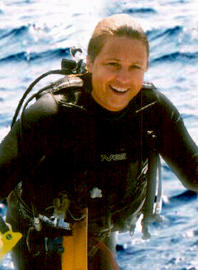
June will mark a change at the helm for REEF. We would like to wish Leda Cunningham well in her future endeavors, and welcome Lisa Mitchell as our new Executive Director. Lisa is eager to bring her extensive experience in the dive industry to REEF, as well as her natural passion for ocean conservation.
Lisa’s involvement with REEF almost goes back to the organization’s inception when, in 1993, she was owner/manager of Baskin in the Sun in Tortola, British Virgin Islands. After participating in a REEF Field Survey she immediately went to work involving BVI dive operators in the new program. In fact, because of her enthusiasm, Tortola became the first destination where 100% of the island’s dive businesses became REEF Field Stations. The REEF staff and Board were so impressed that she was asked to bring her organizational expertise and energies to the Board of Trustees in 1995 where she served until leaving Tortola in 1998 to pursue an Executive MBA at the University of Central Florida.
Lisa is a diver’s diver whose life has evolved around the underwater world. She earned her first scuba certification at age 12 while attending Sea Camp in Big Pine Key, Florida where she later became Assistant Scuba Director. During the following years, while gaining experience working at dive resorts in the Florida Keys and with Peter Hughes in Bonaire, she became a Master Dive Instructor and ultimately an SSI Instructor Certifier, and holds a USCG 100 Ton Master’s License. In the process Lisa has made well over 8,000 dives. To honor her many accomplishments Lisa was inducted into the Women Divers Hall of Fame in 2001.
Most recently Lisa has worked as a marketing and business analysis consultant within the dive industry with clients such as Scuba Schools International (SSI), Expedition Fleet Liveaboards, and Dive Dominica.
It goes without saying the REEF staff and Board are delighted to have Lisa back in the fold, and look forward to many prosperous years with such a capable and energetic Captain at the helm.
REEF members and Lisa’s many friends are invited to join us for a “Welcome Back to REEF and the Keys” evening to be held in her honor at 7 PM June 21st, 2008 at the Amoray Dive Resort in Key Largo.
Author: Andy Dehart, National Aquarium in Washington, DC and REEF Board of Trustee
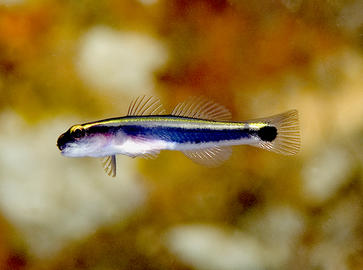
In January, 2008 the National Aquarium Institute organized and conducted a Bahamian conservation expedition on the Aqua Cat live-aboard dive vessel. Our mission was to conduct REEF surveys and work on the invasive lionfish project. On board this trip were Lad Akins (REEF Special Projects Director), Ned and Anna DeLoach, Chris Flook (Bermuda Aquarium), National Aquarium staff, and aquarium and REEF volunteers. In addition to meeting the lionfish research goals of the cruise, we were treated to not one but two exciting and rare finds - the Exuma goby and the lemon goby.
At a dive site in Eleuthera called Cave Rock Reef we geared up and readied ourselves for lionfish behavior monitoring. Just as I started getting my gear together Anna came to the surface to tell me she had found a school of Exuma gobies, Gobiosoma atronasum. What I had not realized was that the keen eye of Bruce Purdy, owner of the Aqua Cat and avid REEF surveyor and supporter had noticed them at this site before and he had directed Anna to the exact coral head. I have logged over 400 dives in the Bahamas and until this day the Exuma goby had always eluded me. To the casual observer this fish looks like a cleaning goby or sharknose goby until you notice its behavior. Unlike most other “neon-type” gobies, the Exuma Goby spends most of its time hovering in the water column, not perched on the coral. They act very similar to the masked and glass gobies. Excited to add a new species to my life list I leave the small cluster of these great fish and head down to my assigned duty of monitoring a lionfish.
Two days later, while on a dive at Blacktip Wall in the Exumas, I noticed a few fish mixed in with school bass. These fish looked out of place and very different from anything I had ever seen. I noted as much detail as possible on my REEF slate and swam on hoping that one of my fellow trip members would be able to help me identify it. As it turns out no one had any idea what it was, but luckily Ned had also seen this odd fish and had taken some great photos of it. After some research when we returned from the trip, we discovered this fish was a lemon goby, Vomerogobius flavus. The lemon goby is an exciting new fish to the REEF database. This species was identified and described in 1971 from 11 Bahamian specimens, but this sighting in the Exumas is a range extension for the species.
It was truly a rewarding experience to finally see and survey the Exuma goby that I have searched for on many trips. To document a fish that I did not even know existed was the icing on the cake. For a fish lover like me, getting to find a new species for the REEF database is an honor. REEF surveying truly keeps diving exciting and new. I am concerned about the effects that the invasive lionfish could have on these two species of gobies with such a narrow range in which they live, but the data from all of our great volunteers helps us track these changes. It would be a shame to lose such unique endemic species due to this foreign invader. We hope you enjoy seeing some of the first photos ever published of these two goby gems.
Author: Lad Akins, Director of Special Projects
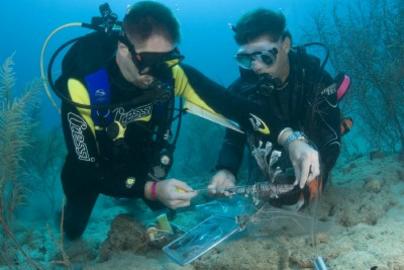
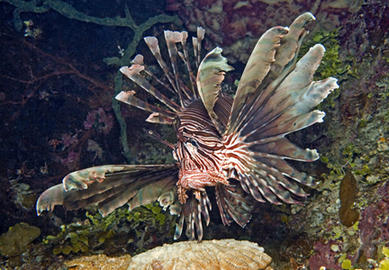
The recent invasion of Indo-Pacific lionfish into Atlantic waters has been causing great concern among researchers, marine park and fisheries managers, and divers. REEF, in partnership with Bahamian dive operators Stuart Cove and Bruce Purdy, NOAA, the United States Geological Service (USGS), the National Aquarium in Washington DC, the Bahamian Government and university groups, has spearheaded the field research for this rapidly expanding problem. As part of REEF’s Lionfish Research Program, over the last two years REEF has coordinated 12 research projects that have involved over 175 REEF volunteers. This research has generated a wealth of in-situ observations and over 1,000 lionfish specimens, which have led to great advances in the understanding of the biology and potential impacts of this most unwanted invader.
REEF’s most recent field project at Stuart Cove’s Dive Bahamas in May 2008, involving over 20 volunteers and researchers, found that the problem continues to get worse. The team gathered data on nearly 200 specimens of lionfish to determine relative abundance, size increases, reproductive status, growth rates, predator prey relationships and movement. Findings included:
Lionfish continue to grow in size: Tagging data show growth rates exceeding 190mm/year, far larger than necessary to reach sexual maturity.
Site Fidelity: All 12 previously-tagged specimens that have been recaptured indicate strong site fidelity even after 6 months.
Prey: Lionfish continue to amaze us during stomach content studies. The recent effort turned up new records including two entire spotted goatfish, a large brown chromis, a small reef octopus, and even a small mollusk in its shell. Lionfishare eating nearly anything that will fit into their mouths.
Reproduction: Lionfish reproduction occurs throughout the year – many gravid females and a small recently settled juveniles have been found.
REEF’s future fieldwork will concentrate on lionfish movement, trap design, habitat preference, and local control measures. Our next project is scheduled to take place at Stuart Cove’s Dive Bahamas in Nassau from September 14-20. If you would like to help with our ongoing work please consider joining us as a field volunteer and/or making a contribution to REEF’s Exotic Species Program.
For more information on REEF’s Exotic Species Program, to volunteer on a future research project or to discuss funding opportunities, contact REEF Director of Special Projects, Lad Akins, Lad@reef.org.
Author: Bonnie Greenberg
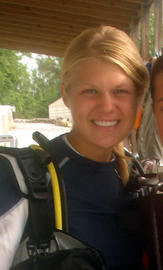
REEF is pleased to welcome Stephanie Roach from Camp Hill, PA as the 2008 REEF Summer Intern and Great Annual Fish Count Coordinator (GAFC). Her internship is supported by the Our World Underwater Scholarship Society. The REEF internship program provides college age juniors, seniors and graduate students the opportunity to experience working at a nonprofit environmental organization. REEF interns assist REEF staff with education, outreach and a multitude of programming. Many REEF interns move on to successful careers in conservation and the marine environment, including natural resource agencies, academics and conservation non-profits (including REEF). In fact, REEF Director of Science, Christy Pattengill-Semmens, Ph.D., is a former REEF intern.
The Our World-Underwater Scholarship Society is a nonprofit, educational organization whose mission is to promote educational activities associated with the underwater world. For over 35 years, they have fostered the development of future leaders of the marine environment through their scholarship and internship programs.
Stephanie graduated this May from Denison University with a Bachelor of Arts in Biology as well as Studio Art. She attended the Skidmore College Summer Six Art Program and the School for Field Studies in the Turks and Caicos where she experienced open water research. By the end of her time in the British West Indies she said, "I realized I wanted to work toward a better understanding of the world's oceans and eco-systems."
As this year's summer intern, Stephanie will act as the primary GAFC coordinator for REEF, along with assisting staff with various activities and preparing and presenting REEF talks and fish ID classes to the Florida Keys community. She will also have an opportunity to present and implement a project which aligns with her interests in combination with REEF needs and activities. She begins her internship June 2 and you can greet her with a happy hello by sending an email to gafc@reef.org or call 305-852-0030 ext. 1#.
If you would like to support future REEF internships, please send your tax-deductible donations to REEF, P.O. Box 246, Key Largo, FL 33037 or click here and make a secure donation online today. For more information, please call 305-852-0030 or email reefhq@reef.org.
Author: Ned DeLoach, REEF Co-Founder and Underwater Photographer/Author
During the last week of April, divers from around the country gathered at Amoray Dive Resort in Key Largo, Florida for a REEF Fish Behavior Tour hosted by Ned and Anna DeLoach. After making two morning dives each day, the group spent their late afternoons and early evenings attending entertaining talks about the myriad fish they encountered on the reef. Lad Akins, REEF’s Special Projects Director, dropped by to explain the science behind the recent invasion of Indo-Pacific lionfish in the western Atlantic. But the highlight of the week was the rare opportunity for everyone to create their own coral garden.
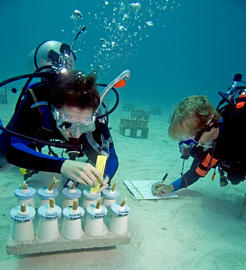
Yes, you read it right: After being giving instructions by coral scientist Ken Nedimyer of the Coral Restoration Foundation, participants headed out the following morning to Ken’s coral nursery located in Hawke Channel where they transplanted cuttings of staghorn coral from a mother colony onto a set of nursery blocks.
After watching 90 percent of the Keys’ staghorn coral die off from a variety of reasons over the past decades, Ken, an aquaculturist by trade, decided to do something about the disheartening problem. In the late 1990’s, he began nurturing small buds of rapidly growing staghorn that by chance settled on his underwater “live rock” farm. Following several years of trial and error, Ken pioneered the first successful method for cultivating and transplanting large quantities of coral. His current success rate hovers at an incredible 90 percent.
After the REEF divers carefully epoxyed their branches on numerically coded pedestals and recorded measurement data, the group headed off to a site on Molasses Reef where, in 1984 the M/V Wellwood, an ocean-going freighter, ran aground destroying 644 square meters of coral reef framework. Federal agencies began extensive restoration of the site in 2002 including emplacement of numerous high-profile limestone modules (click here to read about REEF's post-restoration monitoring of the fish populations on these modules). Unfortunately, to date, the new structures have had limited success recruiting new coral growth. However, the area has one extraordinary success story and the focus of our second dive: Ken’s rapidly growing staghorn coral garden – the two-year result of transplanting nursery grown corals to the grounding site.
Dates for next year’s 2nd Annual Key Largo REEF Fish Behavior Tour at Amoray are scheduled for May 29 to June 5, 2009. The popular fish behavior talks cover Reproductive Strategies, What Fish Eat, Cleaning Stations, Discovering the Night Reef, and Fish Life Cycles. Participants will once again establish their own coral colonies and transplant this year’s nursery crop onto the reef.
Author: Joe Cavanaugh, Director of Field Operations
Once again, it is that time of year when many of you are getting out on the water and conducting REEF Fish Surveys. I have put together a few bullet points based on my experiences surveying with members and answering questions on techniques and things to watch out for when filling out your data sheets. Here are a few tips:
- Roving Diver Surveys mean you are not restricted to a transect line while surveying and you can roam about within 100m of dive boat, mooring buoy, or shore during your survey, drift dives count, of course, and often cover a larger area. The area surveyed does not correlate to your fish sightings, in terms of sighting frequency and abundances, but rather, your time surveying is directly correlated to your sightings data. This is why it is important to fill in the time box on your scanform or on the dataentry page to reflect the time you actually spend surveying, not your total dive time. If you spend 5 minutes prepping to survey and you stop surveying on your safety stop, for instance, than your survey time will not equal your total dive time. Also, as you get better at identifying your fish, try and spend more time looking and searching for fish, and less time looking at your survey slate.
- Set up your slate so that it is easy to get to but not necessarily in your hand throughout your dive. I clip mine with a retractable clip to my BCD and use surgical tubing to hold a graphite pencil, the kind artists use. You can get these at any art supply store and you'll get hundreds of surveys from one pencil providing someone doesn't smoosh it with their dive cylynder! I typically census every couple of minutes or when I see something unique that I don't want to forget. I periodically update my survey so that I really don't have much to add at the end of the dive and I can go through and make revisions while the dive is fresh in my mind. I write in code such as LU (look up) for any fish I need to consult a book about later in the day. I also carry a magnifying glass and a small flashlight to search under ledges and inside sponges for peppermint basslets and sponge cardinalfishes, for instance.
- Use your time wisely when diving deeper profiles on wall dives. As your dive profile changes depending on the site, you can adjust your survey strategy accordingly, to maximize your survey time and the scope of what you see. For wall dives, I personally keep navigation simple, pick an unusual coral head or sponge and mark it in your mind and take a compass heading back to the boat. Make your descent but while you do, search for the type of habitat you are likely to find the fish you are looking for. On a recent trip to Turks I found that at around 100' depth, the Fairy basslets transitioned into Blackcap basslets, at this imaginary line I was likely to find some Cave basslets, or three-line basslets. Then, knowing the dimensions of the cave openings they prefer, you can be choosy about which hiding spots you want to check out. Checking the deeper tube sponges had rewards too in not just finding Sponge cardinals, but also Black brotulas (two for the trip).
- Decide how much time you want to search for different species or families ahead of time. Mike Phelan found with statistical analysis of his personal surveys that he would find 90% of his species in the first 10 minutes of his survey effort on coral reef dives. If you have the luxury of diving a site twice, you can more easily survey the big picture and concentrate on finding cryptic species such as triplefins and other blennies and gobies on the second dive. Or you can focus on abundances for some of those cryptics, seeing how many of one species you can find, increasing Secretary blennies from Few on your first dive to Many on your second dive at the same site.
- Can I count a fish I did not see in the water? The answer is no but here are a couple of examples where I or others have surveyed fish in an atypical manner. Recently, on our Turks Field Survey, I was climbing onto the boat after a night dive when a flyingfish leapt from the water, bouncing off my knee onto the boat deck. I picked him up, identified him as a Mirrorwing flyingfish and threw him back in the water. Did I add him to my survey? Yes, since he was in the water with me during the time of my dive and he was a new survey species for me. I also added a Tripletail to a survey I did last year as I was gearing up on the boat, I saw this Tripletail and snorkeled over to it just before starting my dive. One other quick example came two years ago with our Biscayne Bay AAT project where the group saw a Whale Shark but not on the survey site itself. Some people filled out a species-only survey for this sighting as it was a first for many and a fortuitous sighting as the first time Biscayne Park recorded the species. We created a dive site based on the coordinates. But in general, you can only survey what you are seeing at the time you are actively engaged in your survey. Feel free to email me at joe@reef.org with questions about this or any other questions you might have about surveying techniques.
- Share what you're seeing with other divers, especially your buddy. Surveying is not a competition and its good practice to corroborate your unusual and cryptic sightings with other divers, share your findings with them in the water when you can. This really becomes important when you are with a REEF group and you are trying to get the "lay of the land," sort of speak. Are those Dusky Damselfish I'm seeing everywhere? And are those Secretary or Roughhead blennies I'm seeing. How do I find a Candy basslet, people keep seeing them, can you show me?" Ask questions of your fellow surveyors and take advantage of the unique fish identification and fish finding akumen others have; I sure do on AAT projects. And lastly, feel free to take notes on interesting events such as coral and sponge spawning, rarely seen or odd behaviors of fish, etc. You can post these on one of our REEF forums accessible from our homepage. Photos for this article, courtesy Aggressor II, Turks and Caicos.
Author: Lad Akins, Director of Special Projects
In response to the growing threat of lionfish in the Atlantic and the need for coordinated planning, REEF, NOAA and the USGS are hosting a technical workshop on Non-native Marine Fish Introductions of South Florida in the Florida Keys June 18 and 19. The workshop, jointly funded through a recent Mote Marine Laboratory’s Protect Our Reefs grant, NOAA’s Exotic Species and National Marine Sanctuary Programs and the Gulf and Atlantic States Regional Panel on Aquatic Invasive Species,will bring together personnel from more than 18 different agencies and organizations. Plans for the workshop include presentations by State and Federal agencies, breakout groups and round table discussions that will focus on disseminating the most current information, and drafting a coordinated plan of early detection, notification, and rapid response.
Lionfish have been recorded in large numbers from North Carolina through the Bahamas and are rapidly expanding into the Caribbean. Fortunately, the fish have not yet shown up in the southeast Florida reef tract including Biscayne National Park, the Florida Keys National Marine Sanctuary and the Dry Tortugas National Park and Ecological Reserves. This planning workshop will endeavor to put in place mechanisms to help minimize lionfish impact in these treasured marine protected areas. While lionfish are the “poster fish” of invasive species, the protocols developed in this workshop will be widely applicable for sightings of other non-native marine fish as well, with the goal of preventing future invasions by other species.
REEF will continue to host training and planning workshops, as funding allows, to help downstream countries plan for the arrival of lionfish. Efforts to control populations and minimize impactswill be highlighted as research answers key questions and we are able to develop control methods. To find out more about REEF's Exotic Species Program, contact Lad Akins, Director of Special Projects.
Author: REEF Staff
A Big Win-Win: Have a Great Dive Trip in Key Largo and Support REEFFor REEF Members: Amy Slate’s Amoray Dive Resort will donate 20% of the cost of your Key Largo dive vacation to REEF. This offer of support has no time or package restrictions. Contact the folks at Amoray for more information.
Very Few Spaces Left on 2008 REEF Field Survey TripsStill to come in 2008 are REEF Field Survey trips to Key Largo, St. Vincent, Sea of Cortez, and Cozumel. Very few spaces are left and several trips are sold out, book today. Coming soon -- the 2009 Trip Schedule!
Don't Just Blow Bubbles This Summer! Participate in the 17th Great Annual Fish CountAn exciting lineup of free identification seminars and survey dives are being organized around the country by REEF partners. Check out the GAFC Website for more details and to find out how to organize your own GAFC event. And be sure to watch the GAFC calendar of events to see what's being planned in your area.
Coming Soon -- Online Data Entry For the Northeast and Tropical Eastern PacificFollowing the successful expansion of our Online Data Entry interface for surveys in Hawaii and the Pacific West Coast regions last year, REEF is currently adding the capability for the Northeast (Virginia - Newfoundland) and the Tropical Eastern Pacific (Baja - Galapagos Islands). We hope that this will facilitate an increase in surveying in these important regions. To log your data online, visit http://www.reef.org/dataentry/login.php.