Author: Noa Parks, Citizen Science Coordinator
Join us as we celebrate you and the power of community-driven science. Research findings show that citizen science is an extremely impactful tool when it comes to furthering scientific research. Your contributions to the Volunteer Fish Survey Project are a prime example of this, collecting critical data needed for marine conservation. Every survey you submit helps make a huge difference!
Citizen Science Month is organized by SciStarter, an organization dedicated to connecting people to science. To learn more and view REEF's projects on SciStarter, check out this page.
Author: Christy Pattengill-Semmens, Ph.D., Co-Executive Director: Science & Engagement
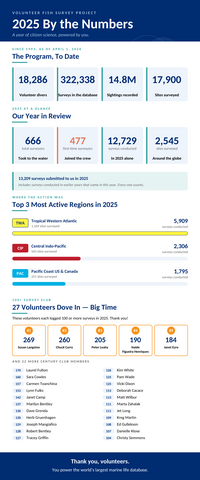
What a year. From 477 brand-new surveyors slipping underwater for the very first time, to 27 dedicated divers each logging 100+ surveys, the Volunteer Fish Survey Project had another remarkable year of citizen science in 2025. Here's what the data tells us — and thank you for making every one of these numbers possible.
Since the program launched in 1993, REEF volunteers have contributed 322,338 surveys and 14.8 million sightings records from 17,900 sites around the world. In 2025 alone, 666 surveyors — including 477 first-timers — conducted 12,729 surveys at 2,545 sites globally.
Author: Janna Nichols, Citizen Science Program Manager
Ever submitted a survey and noticed it did not show up in your account right away? No worries — it takes several weeks, at least, for your surveys to appear in your survey log. Here's a breakdown of how it works.
Your surveys, once submitted, go into a “holding tank.” After a number of them accumulate within each region (TWA, PAC, HAW, etc.), they are gathered and formed into a batch for each region — there are often hundreds of individual surveys per batch — and moved into the error-checking phase of the process. Surveys are both computer and human error-checked, and we send “are you sure?” emails to individual surveyors when we have questions, especially when a sighting is the first record of a species in our database for a given area.
It often takes several weeks to confirm all of the flagged sightings. Once everything is confirmed, all surveys within the batch are processed through to completion.
So, don't be surprised when your data don't show up in your survey log right away. It typically takes 3–4 weeks from submission (and occasionally, even a bit longer than that). You can check the status of your submissions in the My Survey Log report on the REEF website, which has sections for “In Progress,” “Submitted but not yet in review,” “In review but not yet in database,” and “Processed and in database.”
Author: Christy Pattengill-Semmens, Ph.D., Co-Executive Director: Science & Engagement
With almost 350,000 hours of underwater visual survey time collected at more than 17,000 locations around the world over the last 33 years, the REEF Volunteer Fish Survey Project represents one of the most comprehensive marine sightings databases available. We are grateful to you and the thousands of other volunteers who have contributed to this amazing citizen science effort. We are excited to share two recent uses of the REEF database for conservation and ecological studies.
1. Hogfish stock assessment, Gulf of Mexico & East Florida.
Dr. Brice Semmens from Scripps Oceanography participated in a Hogfish fisheries assessment workshop with the South Atlantic Fisheries Science Center. Brice's role in the SEDAR 94 workshop was to explore incorporating REEF data into this population model for Hogfish in the Gulf of Mexico and East Florida/Florida Keys. This resulted in the development of a Unified Reef Visual Census (RVC) and REEF Citizen Science Index, which the Working Group recommended be used as a sensitivity run in the SEDAR 94 stock assessment. This is a great step forward in having REEF VFSP data be included in future NOAA Fisheries Assessments.
2. Sea star wasting disease, Pacific Northwest.
Dr. Drew Harvell from Cornell University recently gave a NOAA webinar titled “How are Salish Sea Stars Faring in our Ocean's Menagerie?”. She discussed the status and trends of sea stars in the face of changing ocean conditions that have fueled the decade-long epidemic of sea star wasting disease. In her talk, she relied heavily on the long-time data series of echinoderms that REEF volunteers have collected in the Pacific Northwest since 2008. The REEF data are critical to validating the continued detrimental impact that many species are experiencing, including Spiny Pink Star and Sunflower Sea Star.
To date, 138 scientific papers and reports have used REEF data. Visit www.REEF.org/db/publications to see the full list.
Author: Stacey Henderson, Field Survey Trips Manager
Last month, we released the 2027 REEF Field Survey Trips schedule, along with a few trips in 2028 and 2029. We have plenty of exciting destinations planned! REEF Trips are led by marine life experts, and include diving, fish ID classes, and fun with like-minded friends. Divers, snorkelers, and families are welcome on REEF Trips.
To find out more or book your space, email trips@REEF.org. For individual trip details and more info, visit the links below or check out www.REEF.org/trips. REEF Trips fill up fast, so don't wait to grab a spot on your favorite destination!
If you are looking for trips in 2026, we still have spaces available on our trips to Cuba and the Philippines. For all of the details, check out www.REEF.org/trips.