
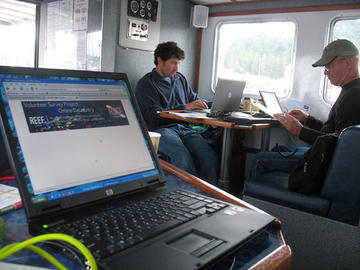
Ever submitted a survey and noticed it did not show up in your account right away? No worries — it takes several weeks, at least, for your surveys to appear in your survey log. Here's a breakdown of how it works.
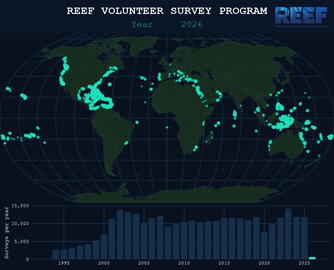
What a year. From 477 brand-new surveyors slipping underwater for the very first time, to 27 dedicated divers each logging 100+ surveys, the Volunteer Fish Survey Project had another remarkable year of citizen science in 2025. Here's what the data tells us — and thank you for making every one of these numbers possible.
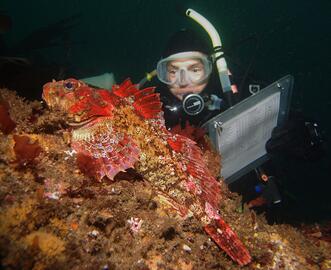
Join us as we celebrate you and the power of community-driven science. Research findings show that citizen science is an extremely impactful tool when it comes to furthering scientific research. Your contributions to the Volunteer Fish Survey Project are a prime example of this, collecting critical data needed for marine conservation. Every survey you submit helps make a huge difference!
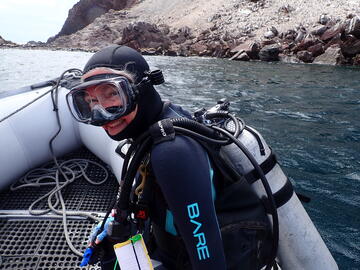
SCUBA divers can collect fish and marine mammal DNA just by swimming! A few years ago, we reported on an exciting collaboration with scientists from Scripps Oceanography that uses cutting-edge technology to improve our understanding of ocean ecosystems. Results from this study were recently published in the scientfic journal, Environmental DNA.
This study tested whether citizen science SCUBA divers could help monitor marine biodiversity using environmental DNA (eDNA), or tiny genetic traces organisms leave behind in seawater. eDNA filters were attached to REEF volunteer divers, who concurrently conducted REEF Volunteer Fish Survey Project surveys. The DNA captured on those filters was then extracted and sequenced, and the species detected were compared to what divers recorded visually during their surveys.
Accurate underwater visual census (UVC) of fish community structure is essential for monitoring ecosystem health, managing fisheries, and evaluating response to stressors on coral reefs. However, comparisons between survey methods often reveal significant differences in species detection and estimated density.
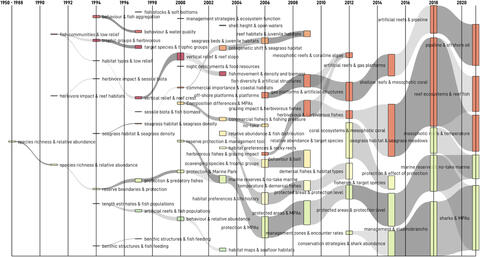
A paper recently published in the journal Fish and Fisheries explores 70 years of visual fish census techniques, including the REEF Volunteer Fish Survey Project. The paper, titled "Global Analysis of Shallow Underwater Fish Observation Research: 70 Years of Progress, Persistent Geographic Biases and a Path Forward," was one output of a multi-year Working Group called CoNCENSUS.
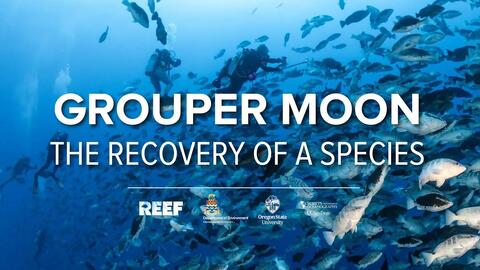
Winter months always bring news of one of REEF's key conservation science efforts - the Grouper Moon Project, a multi-decade conservation success story protecting one of the Caribbean’s most extraordinary natural events: the largest known spawning aggregation of the endangered Nassau Grouper. We are excited to share a new short video that tells this story. Check it out on REEF's YouTube channel "We Speak Fish".
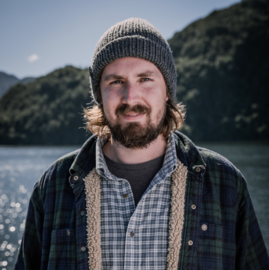
We are excited to welcome Tom Sparke to the REEF Team as Communications Manager. Tom joins us with experience spanning marine science,conservation, and storytelling. He is an accomplished underwater videographer and avid scuba diver. Tom earned a BSc in Marine Biology & Oceanography and an MSc in Tropical Coastal Management from Newcastle University in the United Kingdom. His involvement with REEF began in 2016 as a volunteer scientific diver with the Grouper Moon Project, and he has participated every year since.
Marine ecosystems are increasingly threatened by overfishing, pollution, coastal development and climate change, underscoring the need for long-term, representative information on key fish populations and habitats to inform management and policy. Underwater fish observation techniques, such as Underwater Visual Census (UVC - which includes the REEF Volunteer Fish Survey Project), stereo-Baited Remote Underwater Video (stereo-BRUV), and Remotely Operated Vehicles (ROVs), all play a key role in sustaining long-term data collection.