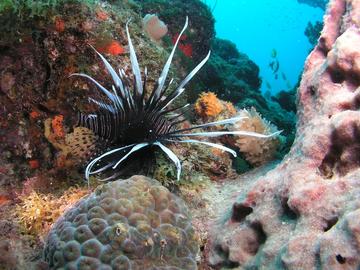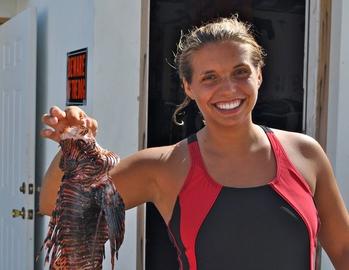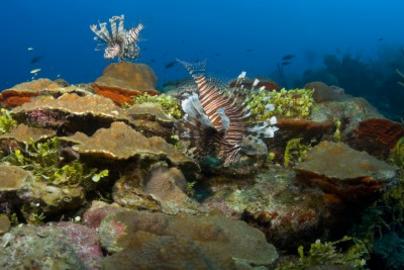
Join REEF in a special presentation on the background of the lionfish invasion, biology and ecology of lionfish, impacts of the lionfish and current research findings as well collecting and handling tools and techniques. After attending the Saturday morning workshop, each participant is welcome to attend optional lionfish handling dives on Saturday afternoon and Sunday morning.
Current search
Search found 723 items
- lionfish
Managing invasive Indo-Pacific lionfish (Pterois volitans and P. miles) in the Western Atlantic Ocean is beyond the capacity of natural resource organizations alone. In response, organizations have mobilized members of the public and citizen scientists to help. The authors used a structured survey to assess the activities and perceptions of 71 organizations that engage the public and citizen scientists in lionfish research and management throughout the invaded range of the Western Atlantic.
As the spread and impact of the invasive Indo-Pacific red lionfish explodes in the western Atlantic region, REEF continues to take a lead in addressing this complex environmental issue. In addition to extensive outreach and education efforts, REEF staff is involved in several field research projects to study the ecological impact of this voracious predator. REEF is also coordinating regional response efforts. In partnership with the International Coral Reef Initiative (ICRI), NOAA, Mexico and France, REEF helped fund and organize the first Regional Lionfish Strategy Workshop in August.
We are excited to welcome the newest member of the REEF Team - Elizabeth Underwood, who joined our staff this month as Lionfish Program Coordinator. Elizabeth has been an active REEF member, avid fish counter, dedicated lionfish hunter, and all-round marine science enthusiast for quite some time. Elizabeth was first introduced to REEF in the Spring 2011 when she studied abroad in the Turks and Caicos Islands and conducted her first of many REEF fish surveys and lionfish studies.
Predation by the invasive Indo-Pacific lionfish impacts native fish populations within the Caribbean region and threatens to expand further into Brazil and the Mediterranean. Identifying the range-restricted native fish species with high predation vulnerability in these areas ahead of the invasion front combined with the knowledge of the time a lionfish population typically takes to reach dangerously high densities could help conservation planners attain positive outcomes and reduce biodiversity loss.
$1,726 per person double occupancy ($2,146 single occupancy) - includes: lodging for 7 nights at the Kura Hulanda Lodge, breakfast each morning, 5 days of 2-tank boat dives, r/t airport transportation on Curacao, ground transportation for group activities, and all taxes.
+$200 REEF Program Fee per diver will be added to each package to cover the cost of the group leader, seminar and survey materials.
The further I dive into the field of science, the more I realize that science must be applied by engaging in public interaction. This concept has been the overwhelming central theme to the week. On Tuesday night, Dr.
WHAT:
REEF, the Reef Environmental Education Foundation, will host a free educational presentation and discussion about the recent invasion of Atlantic waters by Indo-Pacific lionfish. Though no confirmed sightings have been made in the Florida Keys, the fish have become established along the U.S. east coast, Bahamas and Bermuda and are moving rapidly throughout the Caribbean.
This workshop is intended for dive professionals and avid recreational divers interested in obtaining a permit to collect lionfish in the Sanctuary Preservation Areas. These workshops are sponsored by REEF and the Florida Keys National Marine Sanctuary. The workshop presentation will cover the history and progression of the invasion, an overview of lionfish biology and ecology, safe handling and collection techniques, and first aid.
More information at www.REEF.org/lionfish/workshops.
This workshop is intended for dive professionals and avid recreational divers interested in obtaining a permit to collect lionfish in the Sanctuary Preservation Areas. These workshops are sponsored by REEF and the Florida Keys National Marine Sanctuary. The workshop presentation will cover the history and progression of the invasion, an overview of lionfish biology and ecology, safe handling and collection techniques, and first aid.
More information at www.REEF.org/lionfish/workshops.