
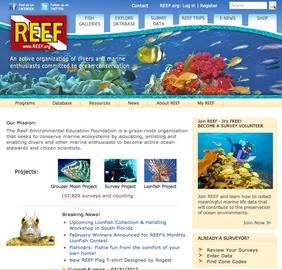
REEF is proud to announce the next generation of our website - www.REEF.org. The redesigned page was launched earlier this month. The website still features the wealth of information, tools, and resources you expect from REEF.org, but now they are highlighted with a new design and user friendly navigation. Aside from the new look, you may notice that the site is much faster due to an upgrade in our server equipment.
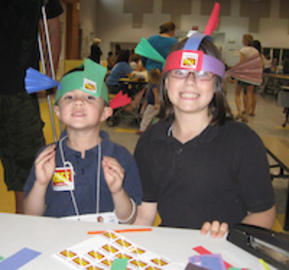
A few weeks ago, in honor of Earth Day, REEF asked for your help in supporting our educational programs. Through classroom and field activities, these programs have inspired thousands of school children, young adults, divers, and researchers. If you haven't already made a donation, please consider making a difference in the life of a future ocean conservationist!
Contribute securely online today at www.REEF.org/contribute
Your donation will ensure that we can provide:
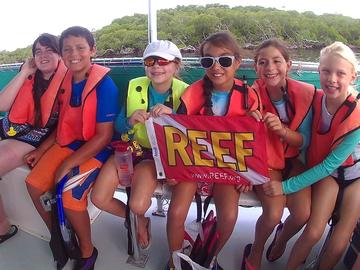
Over the summer, REEF hosted the second year of Ocean Explorers Summer Camp, a marine science camp designed to get kids outdoors and on the water. 57 campers joined us over 4 weeks of camp, and it was a blast! Led by REEF Education Program Manager, Ellie Splain, and assisted by our wonderful Marine Conservation Interns, each week was filled with fun and interesting activities. Campers snorkeled at the coral reef, kayaked through the mangroves, dissected squid, created lionfish jewelry, and even got up close and personal with some animal visitors!
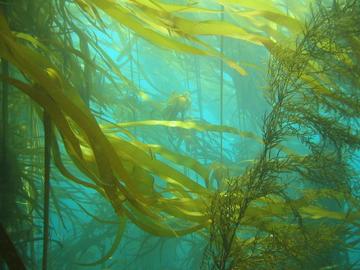
Every month, scientists, government agencies, and other groups request raw data from REEF’s Fish Survey Project database. Recent examples of data requests include:
- Staff from MacArthur State Beach Park in Florida are using REEF data to evaluate fish populations in the park.
- Researchers at SeaDoc Society and Washington Department of Fish and Game are using REEF data to evaluate Northern (Pinto) Abalone in Washington State
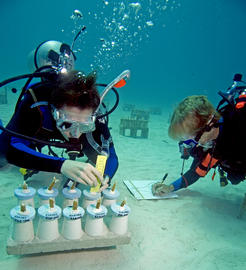
During the last week of April, divers from around the country gathered at Amoray Dive Resort in Key Largo, Florida for a REEF Fish Behavior Tour hosted by Ned and Anna DeLoach. After making two morning dives each day, the group spent their late afternoons and early evenings attending entertaining talks about the myriad fish they encountered on the reef. Lad Akins, REEF’s Special Projects Director, dropped by to explain the science behind the recent invasion of Indo-Pacific lionfish in the western Atlantic.
- Ocean Science 2.0: REEF Pioneers New Approach to Understanding Ocean Ecosystems
- REEF.org Redefined: REEF Launches New Website
- Studying MPAs in the Channel Islands
- Monitoring Artificial Reeefs
- Putting REEF Data to Work
- Online Mapping - A New Data Tool
- REEF's Grouper Moon Project: Conserving a Caribbean Icon
- Lionfish Expeditions Lead to New Information
- REEF Field Stations: Partners on the Ground, In the Water
- Capacity Building in New England
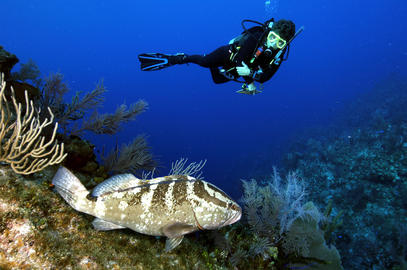
REEF Director of Science, Dr. Christy Pattengill-Semmens, and Grouper Moon Scientists, Dr. Brice Semmens (NOAA) and Dr. Scott Heppell (Oregon State University), participated in the Gulf and Caribbean Fisheries Institute (GCFI) meeting last month in Guadeloupe. This annual meeting brings together scientists, fishermen, resource agency managers, and marine conservation organizations to present and discuss current topics and emerging findings on coral reef resources of the tropical western Atlantic waters.
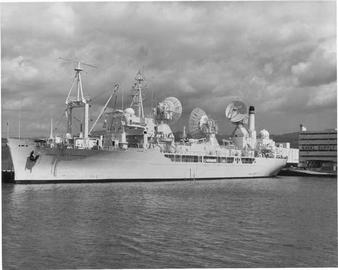
After many years of planning, financial woes and last minute negotiations, it appears that the Hoyt S Vandenberg, a 520-foot troop transport/missile tracking military vessel, will be sunk as the newest artificial reef in the Florida Keys. Recent communication with the State of Florida’s Fish and Wildlife Commission has given the go ahead for REEF to initiate pre-deployment monitoring of the sinking site and 7 other adjacent reef areas to study the recruitment and movement of fish around the wreck and reef sites.
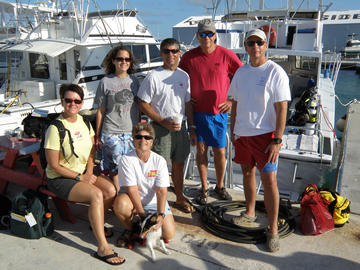
The USS Hoyt Vandenberg is the most recent ship to be placed as an artificial reef in the waters off Key West, Florida. The ship was sunk on May 27, 2009, but three weeks prior to the sinking the REEF team was in action conducting surveys of the sinking site and 7 other adjacent sites for comparison. The data will be used by the State of Florida to document fish recruitment onto the wreck and response of nearby reef sites to the new structure.
Greetings REEF Friends!
This month marks the Great Annual Fish Count (GAFC), REEF's annual event that celebrates our fish survey program. In this issue of REEF-in-Brief we highlight a few of the many GAFC events that were held by our partners throughout the month of July. New REEF staff, Alecia Adamson just returned from the Field Survey to Roatan and her report is below. We are also proud to announce that REEF has facilitated the donation of lionfish collection kits to 27 dive operators in the Florida Keys.