
Join REEF staff Dr. Alli Candelmo for an update on current research findings of the invasive lionfish in the Tropical Western Atlantic.
[Originally scheduled for Wednesday, December 4th, 2019, but rescheduled due to Presenter illness]

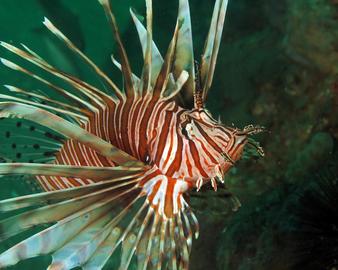
Join REEF staff Dr. Alli Candelmo for an update on current research findings of the invasive lionfish in the Tropical Western Atlantic.
[Originally scheduled for Wednesday, December 4th, 2019, but rescheduled due to Presenter illness]
In this early paper, staff from REEF and NOAA studied feeding ecology of the invasive lionfish (Pterois volitans). The authors collected stomach content data from fishes taken throughout the Bahamian archipelago. Three relative metrics of prey quantity, including percent number, percent frequency, and percent volume, were used to compare three indices of dietary importance. Lionfish largely prey upon teleosts (78% volume) and crustaceans (14% volume).
This article highlights some of the ways that the Upper Keys community has adressed the invasive lionfish, including REEF's 8th Annual Earth Day "Locals" Lionfish Derby held on April 23-25, 2021 in Key Largo.
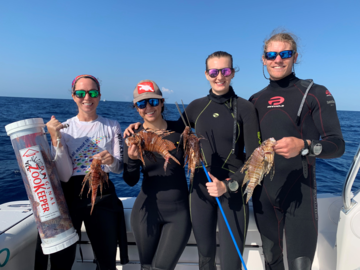
Learn how to safely conduct lionfish removals by attending a REEF Invasive Lionfish Collecting & Handling Workshop.
Workshops include a classroom portion that covers background on the invasion, lionfish biology, ecological impacts, current research, and collecting and handling techniques. After we wrap up the classroom portion of the workshop, we will head out to the water for a 2-tank dive to put our skills to work.
Join us at Florida Keys Brewing Co. on Saturday, August 17, from 4pm-9pm for an exciting night of raising awareness about the threat of invasive lionfish! The event is free and open to the public and will include engaging activities, free lionfish tastings, live music, and family-friendly fun.
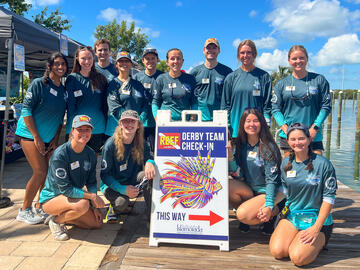
We're gearing up to host the 15th annual REEF Florida Keys Lionfish Derby & Festival on August 15-18! A Lionfish Derby is a competition where teams of divers and snorkelers compete to collect as many invasive lionfish as possible. REEF Lionfish Derbies educate the public about invasive species, gather important scientific information on lionfish populations, and help to develop a consumer market for invasive lionfish.
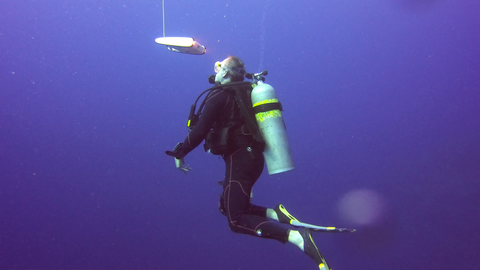
Thanks to the generous support of OpenROV and National Geographic, REEF received two Trident remotely-operated vehicles (ROVs) to advance our research on endangered Nassau Grouper and invasive lionfish.
There is growing concern that lionfish will affect the structure and function of invaded marine ecosystems. Lead author, Stephanie Green, from Simon Fraser University (SFU), along with REEF Director of Special Projects, Lad Akins and other co-authors Aleks Maljković (SFU), and Isabelle Côté (SFU), documented a dramatic 65% decline in 42 species of reef fish eaten by lionfish over a two year period.
Information on fish movement and growth is primarily obtained through the marking and tracking of individuals with external tags, which are usually affixed to anesthetized individuals at the surface. However, the quantity and quality of data obtained by this method is often limited by small sample sizes owing to the time associated with the tagging process, high rates of tagging-related mortality, and displacement of tagged individuals from the initial capture location.