

5K Homepage5K FAQsFish ShoalsSocial Media ToolkitRegistration Open Now
When you register for the Fish Out of Water Virtual 5K, you get to choose which Fish Teams you will join.
The 2026 Fish Teams were selected as some of the most fun and exciting species found throughout the REEF Volunteer Fish Survey Project regions worldwide. Whether you are drawn to the fish because it’s a favorite on your life list, you just like the way it looks, it’s often found in the region where you live or dive, or you connect with the personalities we envisioned for each, we look forward to seeing which Fish Team you join.
Click on the fish icons below to read more about each fish’s race “personality” and a few fun facts.
 |
 |
 |
 |
 |
 Jewel Moray
- Slithering to the finish line
- Is creating the race day hype playlist
- Can always be seen in their spotted race day fit
This striking moray eel species can be found in shallow rocky reefs throughout the Tropical Eastern Pacific region. The jewel Moray is on the smaller end of moray eels, reaching a max size of 2 ft, and can be identified by their distinct yellow spots, each surrounded by a dark ring.
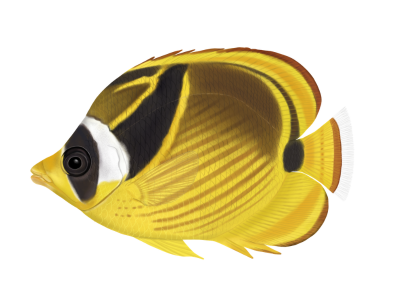
Raccoon Butterflyfish
- Wears shades to protect their eyes while racing
- In charge of race day snacks
- Likes to race with their crew
Named for the black and white “mask” over their eyes, the Raccoon Butterflyfish can be found swimming in pairs or schools in the HAW, TEP, SOP, CIP, and IORS regions. Like other butterflyfish species, they can be seen using their narrow, pointed mouths to eat coral polyps, nudibranchs, tubeworms and other benthic invertebrates.
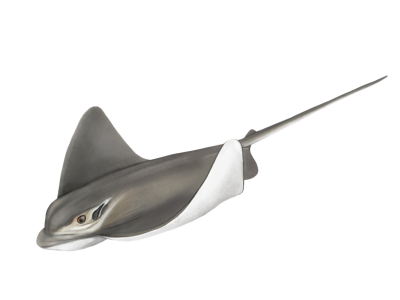
Bat Ray
- Gracefully glides through the race
- So excited for race day that they are jumping for joy
- Ready to crush the competition
Bat Rays are found throughout the waters of California, as well as north to Oregon and south to the Baja peninsula in Mexico. Female Bat Rays can reach a maximum length of 6 ft across, while males are much smaller, reaching a maximum size of 3 ft. They can be found living in a variety of habitats, including sand and mud flats and kelp beds.
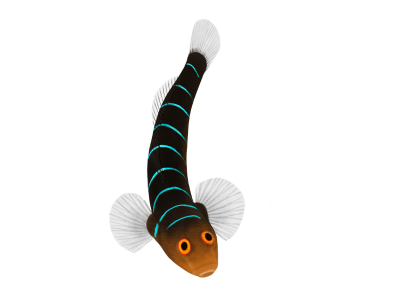 Nineline Goby
- Won't race without their emotional support sea urchin
- Prefers the treadmill, so they can compete from the comfort of home
- Keeping a close eye on the competition and will hide if they get too close
Look under sea urchins in shallow water (10 ft or less) in the Tropical Western Atlantic region for a chance to spot the Nineline Goby. These gobies hide under the sea urchin spines for protection from predators and are known to eat the tube feet of the urchin. They are named for the 9 thin vertical bright blue bars lining their body and are easily identifiable by these bars and the bright red ring surrounding their eyes.
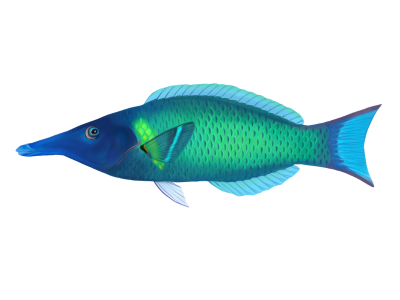 Pacific Bird Wrasse
- Flying through the competition
- Speedy- is going for the gold
- Is very food motivated and will steal snacks from their fellow competitors
Known for their slender body and greatly elongated snout that looks like a bird beak, the Pacific Bird Wrasse can be found in the CIP, SOP, and HAW survey regions. The terminal phase males are dark green in coloration with a blue/ green head and bright mark behind the pectoral fin, while the initial phase has many different colors but always has the long, curved snout.