

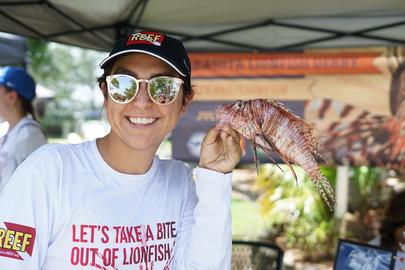
Learn all about the invasive lionfish during this free, online workshop. Topics include background of the invasion, lionfish biology, ecological impacts, current research, and safe collecting and handling techniques.
Current search
Search found 732 items
- lionfish
Last week, representatives from the Florida House and Senate took the first steps in banning the importation or aquaculture of invasive lionfish. Representative Holly Raschein (R-Key Largo) and Senator Greg Evers (R- Pensacola) have filed HB 1069 and SB 1336 to address the devastation being caused by lionfish in Florida’s coastal waters. The bills will prohibit importation, aquaculture and sale of illegally imported lionfish and they authorized FWC to adopt a rule to that effect.
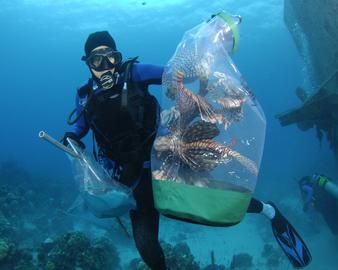
REEF staff co-authored a new publication in the scientific journal PeerJ that features research findings from our Invasive Lionfish Research Program. The paper, titled "Setting the record straight on invasive lionfish control: Culling works", evaluates the effectiveness of lionfish removal efforts. Frequent culling of the invasive Indo-Pacific Lionfish throughout the Caribbean has been shown to cause a shift towards more wary and reclusive behavior by lionfish, which has prompted calls for halting culls.
Thanks for your interest in the 2019 Pompano Beach Lionfish Derby, organized by Shipwreck Park Pompano Beach.
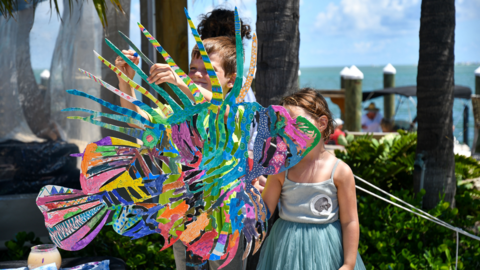
We are so excited for the 16th annual Florida Keys Lionfish Derby & Arts Festival! Starting this year, we are combining the Florida Keys Lionfish Derby with the annual Arts & Science Festival to form a conservation and arts festival! It will all take place at the REEF Campus and will feature vendors including artisans and local non-profits, along with lionfish scoring, fun conservation science and art activities, music, educational and cooking demos, food trucks and drinks, free lionfish tastings, raffle, and derby awards ceremony!
The Indo-Pacific lionfish invasion front is rapidly moving south into the Caribbean. Through REEF’s on-the-ground work, lionfish impacts are being documented in the Bahamas and initial results suggest these impacts will be devastating. Belize saw their first lionfish in 2008, and they are spreading fast. Divers are starting to see more fish on more sites. Now, Belizean organizations are offering a $50.00 per fish bounty to remove the fish before they become established.
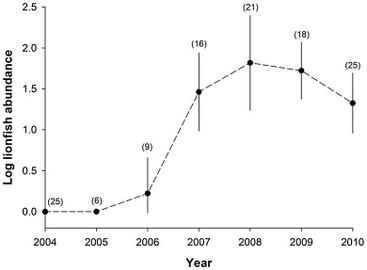
There is growing concern that lionfish will affect the structure and function of invaded marine ecosystems. REEF Director of Special Projects, Lad Akins, is a co-author on a recently published paper evaluating these effects. The study was published in the scientific journal, PLoS ONE. Lead author, Stephanie Green, from Simon Fraser University (SFU), along with Akins and other co-authors Aleks Maljković (SFU), and Isabelle Côté (SFU), documented a dramatic 65% decline in 42 species of reef fish eaten by lionfish over a two year period.
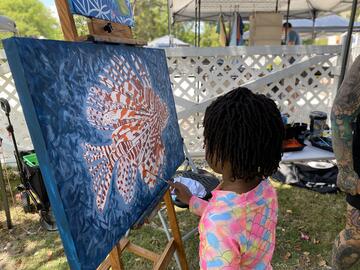
Mark your calendars! The 16th Annual Florida Keys Lionfish Derby & Arts Festival is coming up this month, on April 24-27, 2025. This event blends ocean conservation, art, science, and community fun, and it's free and open to the public! Join us for a weekend of lionfish hunting, eco-art, ocean education, and family-friendly festivities. The Lionfish Derby engages divers in a thrilling competition to remove as many invasive lionfish as possible, helping protect native marine ecosystems.
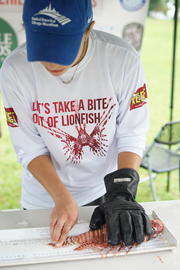
Last month, REEF kicked off our 2018 Lionfish Derby series at the Phillip and Patricia Frost Museum of Science in Miami. Four teams competed on June 9 and 10 to bring in a total of 309 fish. The largest lionfish caught was 411mm (just over 16 inches) and the smallest was 112mm (about 4.5 inches.) We have two more derbies coming up this month - in Sarasota at Mote Marine Lab and Aquarium on July 6 - 8, and in Ft. Lauderdale at 15th St. Fisheries on July 13 - 14, and a few more later this summer and fall.